

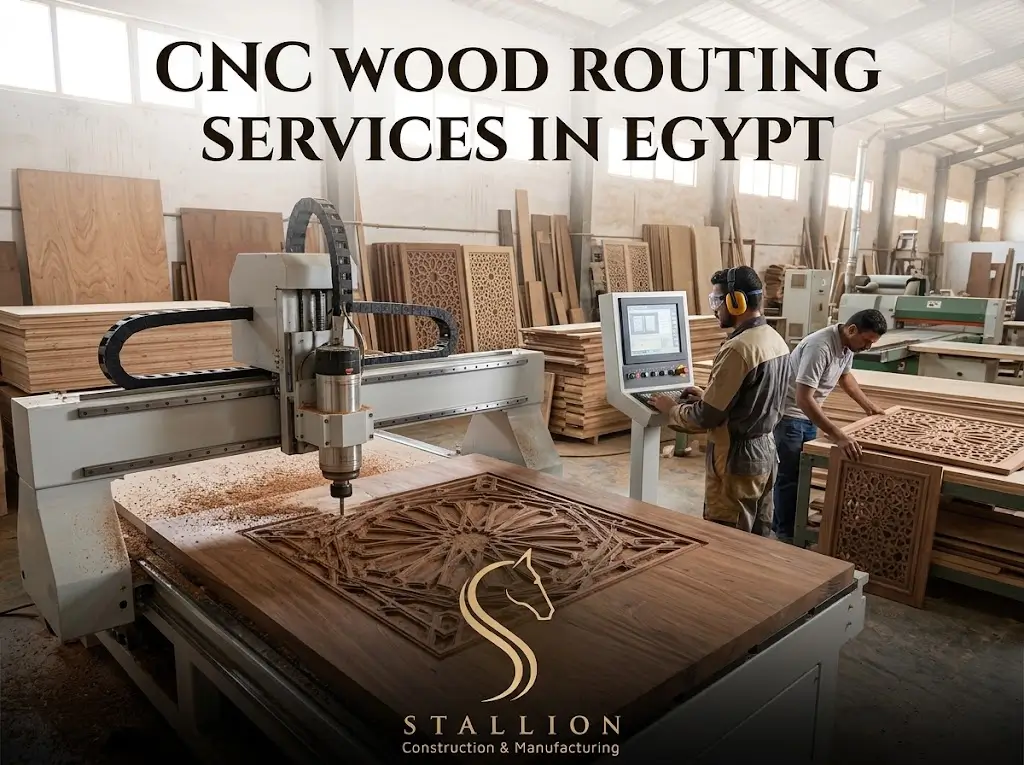
CNC Wood Routing Services in Egypt
Stallion uses CNC wood routing as part of its interior projects and complete furnishing commissions. Within the Giza workshop, digital machining supports panels, profiles and project-specific joinery, coordinated with assembly, finishing and installation where included in scope. This guide explains how to prepare a manufacturing brief, what affects cost and timing, and when a separate 4-axis strategy is appropriate.
CNC within complete furnishing projects
Stallion uses CNC machining within its own interior and manufacturing projects, or as part of a complete furnishing commission. The machining work is coordinated with the wider joinery, assembly and finishing scope.

A carved wooden landscape panel from Stallion’s work, illustrating decorative woodwork that can form part of a complete interior or furnishing project.
What CNC Routing Is Best Suited For
· Panel cutting and profiling for project-specific joinery.
· Openings, pockets, recesses and routed details based on approved drawings.
· Drilling or hardware patterns where the tooling and setup are appropriate.
· Repeated components that benefit from the same digital geometry.
· Decorative grooves, fluting and relief work within the machine and tooling limits.
· Templates, jigs and production aids for repeat manufacturing.
What to share for a furnishing project review
Start with the overall interior or furnishing brief, then identify the components that may need CNC machining. Useful information includes:
- Available plans and drawings, with dimensions and units clearly stated.
- The proposed material, board thickness and finish, or the options that still need to be selected.
- Quantities and repeated components, including any grain-direction or matching requirements.
- The faces to be machined, fixing details and interfaces with other components.
- Whether the agreed scope includes assembly, finishing, delivery and installation.
- Site location, access constraints and the required project programme.
The manufacturing team should confirm suitable file formats and whether the drawings contain enough information before programming begins. Sharing a file alone does not establish that it is ready for production.
From CAD Drawing to Machining Strategy
A CNC-ready drawing should define geometry, material thickness, finished dimensions, machining faces, reference points and any required allowances. The CAM stage then converts that information into toolpaths, cutting strategies and machining sequences suited to the component.
Good CNC work depends on the input data. An unresolved design does not become correct simply because it is machined digitally.
Materials and Tooling Must Be Matched
Different timbers, MDF, plywood and veneered panels respond differently to cutting direction, tool geometry, feed strategy and edge treatment. The manufacturing plan should consider the material and finish rather than apply one generic routing strategy to every board.
Nesting and Material Efficiency
For sheet-based work, digital nesting can help organize multiple parts within the available board size. Material yield is one consideration, but grain direction, veneer matching, edge requirements, part labelling and installation sequence may be equally important.
Tolerance and Repeatability
CNC supports high repeatability, but finished accuracy depends on the complete setup: machine calibration, tooling, material stability, hold-down, programming, measurement and downstream assembly. For that reason, the useful promise is controlled, repeatable production - not unrealistic 'zero tolerance' or 'micron-perfect' marketing language.
What affects manufacturing cost and timing?
For a complete furnishing project, machining is one part of the overall cost and programme. Review the following with the project team:
- Geometry and preparation: complex shapes, multiple machining faces and additional programming can require more preparation than straightforward panel profiles.
- Material and finish: stock selection, thickness, edge treatment, sanding and finishing affect the work after machining as well as the cutting stage.
- Quantity and repetition: repeated components may share an approved setup, while different parts can need separate preparation and checks.
- Assembly and installation: hardware, trial fitting, delivery and site access must be considered within the full furnishing scope.
- Approvals and availability: drawing approvals, material lead times and an agreed sample where required influence the production programme.
A quotation and delivery commitment should therefore follow review of the project scope and specifications. Confirm exclusions and assess approved changes for their cost and programme impact before the affected work proceeds.
CNC Routing Within a Joinery Project
Routing is one production stage. Components may still require assembly, sanding, edge treatment, finishing, hardware installation, trial fitting and final site adjustment. The manufacturing workflow should therefore connect CNC output to the finished joinery rather than treat the routed panel as the final product.
When a Separate 4-Axis Strategy Is Needed
Most panel and profile routing within a furnishing project can use a standard CNC workflow. Curved, rotary or multi-side components may require a different setup and machining strategy. Stallion addresses that more specialized use case separately through its 4-axis CNC capability.
Frequently Asked Questions
Is this a standalone CNC cutting service?
Stallion uses CNC within its own projects and complete furnishing commissions. The service described here is part of an integrated manufacturing scope, rather than a standalone small-job panel-cutting offer.
Can I supply materials or choose a specific file format?
Confirm these requirements with the manufacturing team for the particular project. Material suitability, stock condition and file compatibility need to be reviewed before they are included in the agreed scope.
What is CNC wood routing used for?
It can be used for profiles, cut-outs, pockets, grooves, drilling patterns, repeated components and decorative routed work depending on the material, tooling and machine setup.
Does Stallion use a 4-axis CNC?
Yes. Stallion's confirmed workshop setup includes a 4-axis CNC machine.
Can CNC routing work from CAD drawings?
Yes, but production requires suitable geometry and CAM preparation. The drawings should define material, dimensions and machining requirements clearly.
Is CNC routing automatically more accurate than every manual process?
It improves repeatability when the machine, tooling, programming and material setup are controlled, but overall quality still depends on the complete production workflow.
Can routing be integrated with full joinery manufacturing?
Yes. Where included in scope, CNC-machined components can continue through assembly, finishing and installation within Stallion's manufacturing workflow.
Start with a Defined Manufacturing Brief
For an interior project or complete furnishing commission, share the overall brief, available drawings, material preferences and required finishes. Stallion can review where CNC-machined components fit within the agreed manufacturing and delivery scope.
· Office: 27 Abdel Hamid Lotfy, Mohandseen, Giza, Egypt
Explore related manufacturing capabilities
Read our 4-axis CNC wood carving guide for the separate machining considerations of curved and multi-side components.
See how CNC machining fits within Stallion’s manufacturing workflow, from component preparation to assembly and finishing.