
4-axis CNC wood carving in Egypt
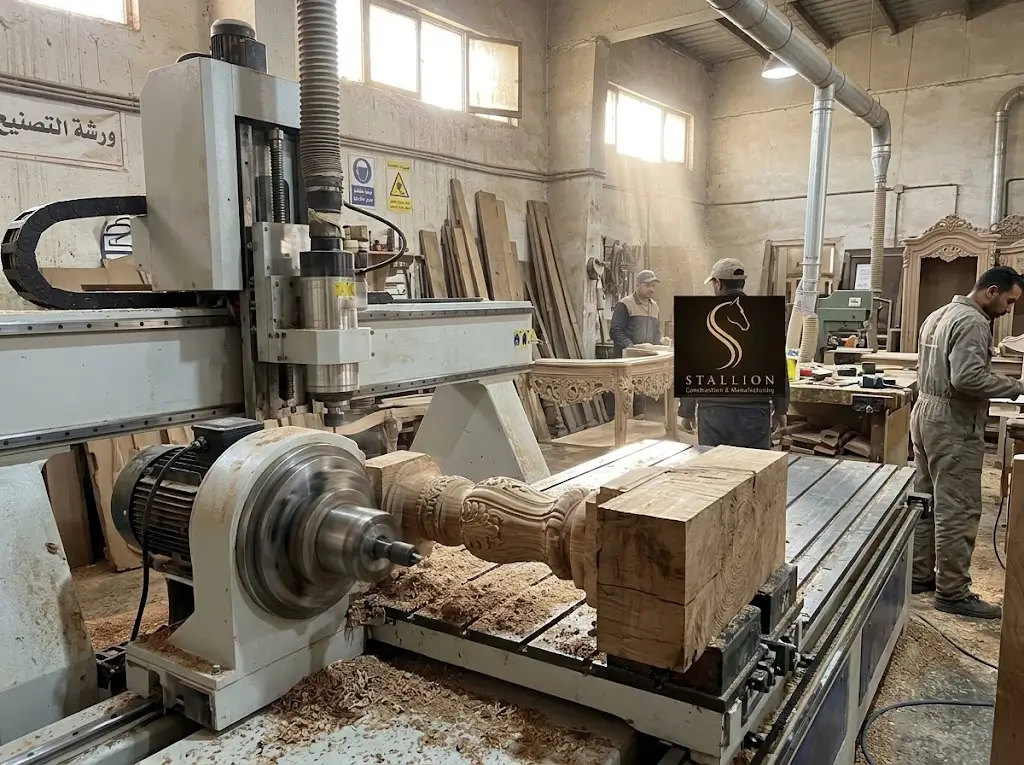
4-axis CNC wood carving in Egypt becomes relevant when a component cannot be described efficiently as a flat panel with simple X-Y-Z machining. Adding a controlled rotational axis allows the machining strategy to address geometry around or across more than one side of a component, depending on the machine configuration, tooling and setup. Stallion Construction & Manufacturing, founded in 2020, operates a 4-axis CNC within its 1,200 m² Giza manufacturing workshop. The capability supports more complex joinery and furniture components where the approved design requires curved, sculptural, or multi-sided machining.
How 4-Axis Work Differs from Standard Panel Routing
Standard routing is well suited to flat sheets, pockets, profiles, cut-outs and many decorative patterns. A 4-axis setup expands the machining possibilities when the workpiece or toolpath needs controlled rotation.
It does not mean every project should use the fourth axis; the simplest reliable machining strategy is usually the best one.
Applications for Curved and Sculptural Components
· Curved furniture parts and complex edge profiles.
· Rotary or near-cylindrical timber elements where the machine setup allows it.
· Sculptural reception desks and feature components.
· Decorative reliefs that benefit from indexed or multi-side machining.
· Special joinery details that would otherwise require repeated manual repositioning.
· Prototype components for bespoke furniture and architectural features.
Design for Manufacturing Comes First
Complex geometry should be reviewed before machining begins. The design must account for stock size, tool reach, cutter diameter, clamping or hold-down, access to each surface, safe clearances and the order in which material is removed. A visually attractive 3D model is not automatically a machinable model.
CAM Strategy and Simulation
The CAM stage determines how the digital model will be cut. Toolpath selection, step-over, step-down, rotation or indexing strategy, roughing, finishing and safe linking moves should be chosen for the actual geometry. For complex components, simulation and verification are essential before machining.
Material Behaviour Still Matters
Solid timber, MDF, plywood and other engineered products behave differently under machining. Grain direction, internal stress, tear-out risk, tool sharpness and surface finishing requirements affect the production strategy. CNC precision cannot compensate for an unsuitable material or unstable stock.
Prototype Before Repeating Complex Geometry
Where a complex component will be repeated, producing and checking a first article can save material and time. The prototype can confirm geometry, tool marks, assembly interfaces, sanding requirements and finishing before the production run continues.
From CNC Component to Finished Joinery
A machined component may still require sanding, hand finishing, assembly with other materials, hardware installation and site fitting. Stallion treats the 4-axis CNC as part of the manufacturing chain rather than as a standalone visual feature.
When Standard CNC Routing Is the Better Choice
If a project only needs panel cutting, pockets, drilling patterns, grooves or standard profiles, the general CNC routing workflow is usually sufficient. The 4-axis strategy is most valuable when the geometry itself justifies the additional setup and programming.
Frequently Asked Questions
What does the fourth axis add to CNC woodworking?
It adds controlled rotational movement, allowing certain components to be machined around or across additional orientations depending on the machine setup.
Is 4-axis CNC only for carving?
No. It can support curved, rotary, indexed or multi-side machining strategies as well as some complex joinery components.
Can any 3D model be sent directly to the machine?
No. The model must be reviewed for manufacturability, stock, tool access, safe setup and CAM strategy before machining.
Why is simulation important?
Simulation helps verify toolpaths, clearances and machining sequence before material is cut, especially on complex geometry.
Does Stallion offer 4-axis CNC as part of finished joinery?
Yes, within the agreed manufacturing scope. Whether a CNC-only service is appropriate should be confirmed case by case.
Start with a Defined Manufacturing Brief
For curved, rotary or complex wood geometry, Stallion can review the 3D model, stock, machining access and required finish before defining the 4-axis production strategy.
· Office: 27 Abdel Hamid Lotfy, Mohandseen, Giza, Egypt