
Custom Furniture Manufacturing in Egyp
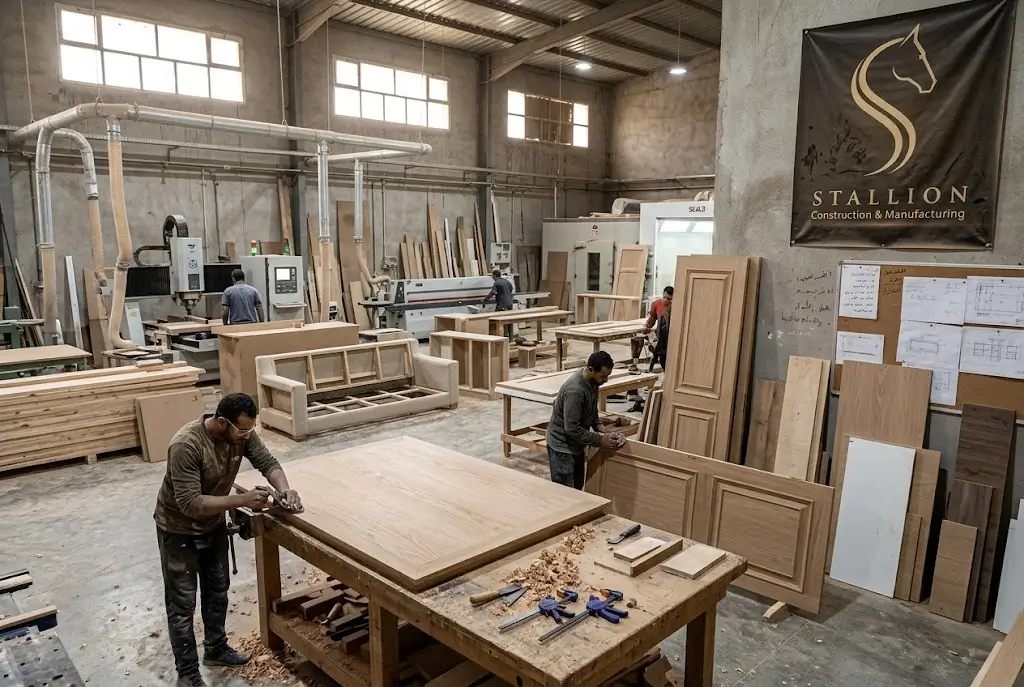
Premium spaces demand more than standard solutions—they require tailored furniture that embodies their functional and aesthetic vision. Stallion redefines custom furniture manufacturing across Egypt’s hospitality, corporate, and luxury residential markets. Powered by our 1,200 m² Giza facility and state-of-the-art 4-axis CNC machinery, we merge engineering precision with fine craftsmanship to deliver everything from executive desks to built-in millwork. From raw material sourcing to on-site installation, we execute every detail to the highest standard of excellence.
Custom furniture manufacturing in Egypt is most useful when a project requires furniture to respond to exact dimensions, circulation, material palettes and architectural details rather than forcing the space to accept standard catalogue sizes. The process is not simply carpentry; it combines design development, technical detailing, controlled fabrication, finishing and installation.
Founded in 2020, Stallion Construction & Manufacturing combines design, site execution and an in-house 1,200 m² Giza workshop. The workshop includes a confirmed 4-axis CNC capability used within the wider manufacturing process for project-specific furniture and joinery.
Where Custom Furniture Adds Value
Custom manufacturing is particularly useful for pieces whose proportions, interfaces or finish need to align with the architecture. Examples include dining tables sized to a specific room, executive desks coordinated with cable management, custom headboards, consoles, media units, benches, reception pieces and furniture developed around unusual wall lengths or circulation constraints.
The advantage is not that every item must be unique. The advantage is that dimensions, materials and construction can be chosen deliberately for the project rather than inherited from a retail catalogue.
1. Start with the Design Brief and Real Dimensions
A production-ready furniture brief should identify use, dimensions, expected loads, material direction, finish, hardware, service interfaces and installation constraints. Where the furniture touches walls, floors, electrical points or other built-in elements, site information should be checked before final detailing.
2. Convert the Concept into Shop Drawings
A rendered image is not enough for manufacturing. Shop drawings should resolve overall dimensions, sections, joints, internal frames, material thicknesses, edge details, hardware and any metal, glass, stone or lighting components. This is the stage where an attractive concept becomes a buildable object.
3. Prototype the Details That Matter
For a one-off statement piece or a repeated item, a sample can resolve issues before full production. Timber tone, veneer direction, lacquer sheen, metal finish, upholstery interface, drawer action and edge profiles are easier to approve on a physical sample than through a screen alone.
4. Use CNC Where Repeatability or Complex Geometry Requires It
Stallion’s 4-axis CNC capability supports repeatable routing, profiling and more complex geometry where manual methods would be slower or less consistent. CNC is one tool within the production workflow; material behaviour, joint design, finishing quality and final assembly still determine whether the finished piece performs well.
5. Finishing Is Part of the Engineering
The selected finish should suit the material, location and maintenance expectations. Natural timber and veneer show normal variation. Lacquered surfaces require stable substrates and controlled preparation. Metal, glass and stone components should be coordinated with the furniture structure before final assembly.
6. Installation and Final Adjustment
Furniture that interacts with the building should be checked against the actual site before handover. Final installation can include levelling, alignment, hardware adjustment, connection of integrated lighting or services, protection of finished surfaces and documented snagging.
Custom Furniture vs. Architectural Joinery
Custom furniture and architectural joinery overlap, but they are not identical. Furniture is usually a discrete object or movable/semi-fixed element. Architectural joinery is more closely integrated into walls, openings, kitchens, wardrobes, panelling and built-in storage. Keeping those intents separate helps clients define the correct manufacturing scope.
Frequently Asked Questions
What does custom furniture manufacturing in Egypt include?
Depending on the brief, it can include design development, measured dimensions, shop drawings, material and finish approval, CNC or conventional machining, assembly, finishing, delivery and installation.
Can one-off pieces be manufactured?
Yes, subject to the agreed scope and technical feasibility. Custom manufacturing is often most valuable where a unique proportion or detail is required.
Does CNC replace craftsmanship?
No. CNC improves repeatability and can handle geometry efficiently, but material selection, joint design, assembly, sanding, finishing and installation remain critical.
Can furniture be coordinated with the interior fit-out?
Yes. Where Stallion is responsible for the wider project, furniture dimensions and services can be coordinated with architecture, MEP and site conditions before production.
Is production time always the same?
No. Lead time depends on design complexity, material availability, approvals, quantity, finishing and installation requirements.
If your project requires bespoke furniture rather than standard catalogue pieces, Stallion can review the brief, dimensions, material direction and production requirements before shop drawings and fabrication begin.
·